Most of us walk out of that appointment with half the panel and a reassuring smile. Not because anyone is being obstructive, but because a ten-minute slot rewards brevity and you have not had time to think about what to ask for.
So here is the list, and the wording. Print it, or read it off your phone. Nobody minds. Well, almost nobody.
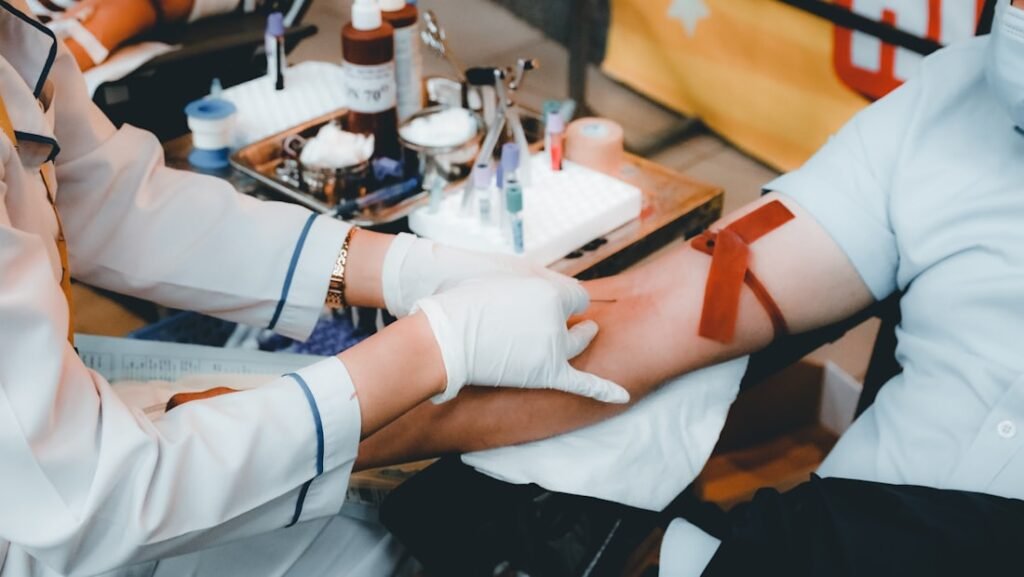
What to ask for, and why
Fasting insulin. The one most often omitted and often the most revealing. Glucose can sit in range for years while insulin climbs to keep it there — the mechanism is in this guide.
HbA1c. Average glucose over roughly three months.
Total and free testosterone. Free is the fraction that is biologically active. Total alone can look normal while free is raised.
SHBG. The protein that binds testosterone. Low SHBG raises free testosterone even when total is unremarkable, and it drops with insulin resistance.
DHEA-S. The adrenal androgen. Raised DHEA-S with normal ovarian markers points toward the stress side.
LH and FSH. An elevated LH to FSH ratio is a common but not universal PCOS pattern.
TSH and free T4. Thyroid dysfunction mimics a great deal of PCOS and is easily missed.
25-hydroxyvitamin D. Deficiency is more common in PCOS and worth correcting.
Ferritin. Heavy periods plus low ferritin is extremely common and badly under-treated.
Timing matters
Sex hormones are usually taken on days 2 to 5 of your cycle. Fasting bloods mean genuinely fasting — water only, ideally first thing.
If you are on hormonal contraception, say so, because it changes how several of these are interpreted. And if your cycles are irregular, ask when to come in rather than guessing.
The wording
“I have symptoms consistent with PCOS — irregular cycles, jawline acne and persistent fatigue. I would like a full hormonal and metabolic panel so we can rule things in or out properly. Could we include fasting insulin alongside glucose, and SHBG with the testosterone?”
Naming symptoms first gives the request a clinical justification. Asking for specific tests rather than “everything” makes it straightforward to agree to. Leading with fasting insulin and SHBG works because those are the two most commonly left off.
If you get a no
Ask what would need to be true for the test to be indicated, and ask for that to be recorded in your notes.
It is a calm, non-confrontational question, and it does one of two things: it gets you the test, or it gets you a genuine clinical reason you can then look into. Both are progress, and neither requires an argument.
When you get the results
Ask for the actual numbers and the reference ranges, not just “normal.” Ranges vary between labs, and several of these markers can sit at the edge of normal while still being clinically relevant.
Keep them. A second set in a year is far more informative than a first set alone.
Questions people actually ask
Can I just order private tests?
You can, and sometimes it is faster. The downside is interpreting them without clinical context, and private panels often include expensive tests of limited value — somewhere a wellness company is selling a vitamin D test you could get free from your GP with the right sentence. If you do, take the results to a clinician.
Why will my GP not test fasting insulin?
It is not part of standard diabetes screening pathways in many health systems, so it is genuinely unfamiliar rather than deliberately withheld. Framing it around PCOS assessment rather than diabetes helps.
Do I need an AMH test?
It is increasingly used in PCOS assessment but is not a diagnostic criterion. Useful information, not essential.
What if everything comes back normal?
That is genuinely useful and does not mean your symptoms are imagined. It redirects the investigation — thyroid, iron, sleep apnoea and coeliac all produce overlapping pictures.
What to do with the answers is in the four-step path.
Where this comes from
- Monash University — International Evidence-Based Guideline for PCOS
- NHS — PCOS diagnosis
- Lab Tests Online UK — understanding your tests
- PubMed — HOMA-IR as a measure of insulin resistance
Links open in a new tab. Where a claim rests on a small or mixed body of evidence, that is stated in the text above.